The ongoing conversation about traffic safety in Centennial is expanding beyond Smoky Hill Road.
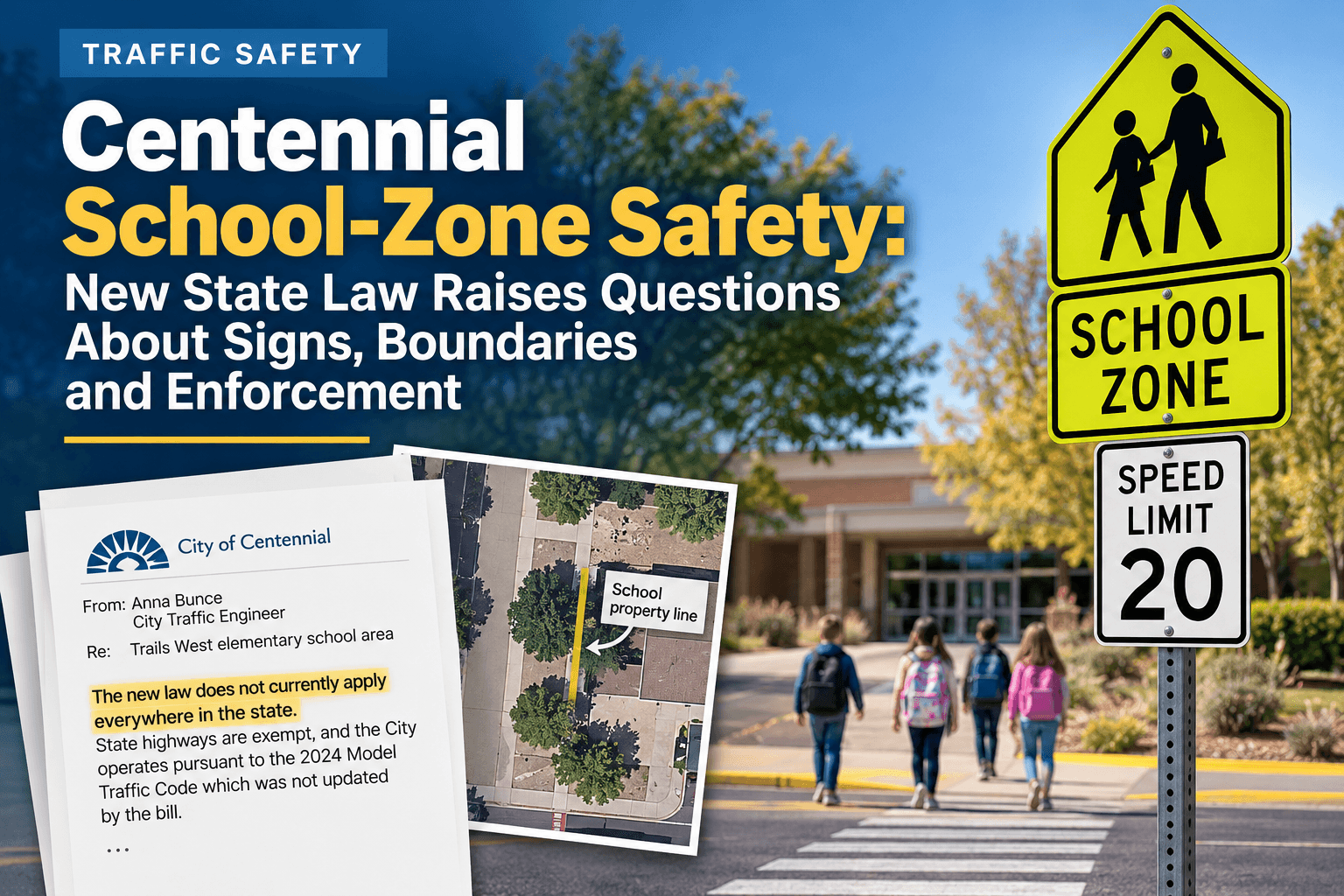
Addison Perrott, who has been working with other residents on transportation safety and a developing Safe Routes to School initiative, recently shared correspondence between the City of Centennial and a resident who asked the City to reconsider the boundaries of the school zone near Trails West Elementary School.
The resident asked that the school zone be extended, citing a new Colorado law governing school-zone distances. The City's response acknowledged the new legislation but raised a question that residents now want clarified: does Centennial believe the new state requirements fully apply to City streets, or does its adoption of an older Model Traffic Code change how the City intends to implement them?
That question matters because the state law is now in effect.
What Colorado’s New School-Zone Law Actually Says
Colorado's HB26-1318, the Liam Stewart School Zone Act, took effect August 12, 2026. The law substantially changed the state's definition of a school zone.
Under the enacted law, school zones generally encompass roadways within at least 1,000 feet of a school property boundary. Existing school zones that were already more than 200 feet from a school boundary when the law took effect may remain at their existing size. But if an existing zone is less than 200 feet from the school property boundary, the law says the county, city and county, or municipality with jurisdiction must increase it to a minimum of 200 feet. A local government may reduce a school zone below 1,000 feet, but not below 200 feet, and it must first hold a public hearing. State highways are treated separately and generally require Colorado Department of Transportation involvement. Colorado General Assembly
The law also requires appropriate signage identifying school zones and indicating that penalties and surcharges are doubled. Colorado General Assembly
Residents can read the legislation directly through the Colorado General Assembly's HB26-1318 page.
What Centennial Told a Resident
In the email provided to Centennial Pulse, Centennial City Traffic Engineer Anna Bunce wrote that the new state law updated requirements related to signs showing that fines are doubled in school zones.
The City's response then stated that the new law “does not currently apply everywhere in the state,” noting that state highways are exempt and adding that Centennial operates under the 2024 Model Traffic Code, which was not updated by the bill. The email went on to explain that Centennial has funded a citywide school safety study expected to examine K-12 transportation conditions, including potential inconsistencies in speed reductions, signage, striping and other safety measures.
That response is what has residents asking for further clarification.
Centennial did, in fact, adopt the 2024 Model Traffic Code by ordinance, and the City's municipal code says the purpose of that adoption is to maintain traffic regulations consistent with state law. City of Centennial
At the same time, HB26-1318 was enacted in 2026 and repeatedly assigns responsibilities directly to counties, cities and municipalities. We did not find a general exemption in the enacted law saying a municipality is excused from its school-zone requirements simply because it previously adopted the 2024 Model Traffic Code. Colorado General Assembly
That does not mean Centennial Pulse is making a legal determination about how the City's home-rule authority interacts with the new statute. It does mean the public deserves a clearer explanation of the City's interpretation.
A useful question for Centennial would be:
Does the City believe HB26-1318 requires existing Centennial school zones shorter than 200 feet from a school property boundary to be extended, and if not, what legal provision is the City relying upon?
That answer would remove considerable fog from the conversation.
Why Trails West Is Getting Attention
Trails West Elementary School is located at 5400 S. Waco Street in Centennial and serves students from pre-K through fifth grade. Colorado Department of Education
Perrott says the current school-zone markings around Trails West are an example of why residents want the City's school safety study to look carefully at actual field conditions, rather than relying only on existing designations.
She also provided an important correction to something we previously reported.
In an earlier Centennial Pulse article, we described the Trails West school zone as extending roughly 30 feet from the school. That wording was inaccurate. Perrott's clarification is that, based on the Google Maps images residents are reviewing, the marked zone appears to extend only about 30 feet into the school property from the property-line reference, rather than the entire school zone itself being only 30 feet long.
We have not independently surveyed the location, so that approximate measurement should not be treated as an engineering determination. But the distinction matters because the new state law measures school-zone distances from the school property boundary.
That makes the actual location of the boundary, and the placement of the signs relative to it, something that can be measured rather than debated.
What About an “End School Zone” Sign?
Residents have also raised concern about whether drivers are clearly told when the school zone, and particularly the double-fine portion of it, ends.
This question has a separate layer of traffic-control standards behind it.
Colorado adopted the current edition of the Manual on Uniform Traffic Control Devices, or MUTCD, along with a Colorado supplement. CDOT says use of the MUTCD is mandatory on public highways, roads and streets across Colorado. Colorado Department of Transportation
The school-area section states that when increased fines apply within a designated school zone, an END HIGHER FINES ZONE or END SCHOOL ZONE sign is to be installed at the downstream end so drivers know where the heightened-fine zone terminates. MUTCD 11th Edition, Revision 1
That makes residents' question about end signage legitimate.
It does not, by itself, establish that Trails West or another Centennial school zone is currently violating the MUTCD. Determining that would require confirming the actual sign inventory, direction of travel, school-zone designation and any applicable implementation provisions for existing signs.
But it gives the City a very practical question to answer:
At each Centennial school zone where double fines are imposed, are both the beginning and ending boundaries clearly signed according to current standards?
That should be answerable through the City's upcoming study.
The School Safety Study Is Becoming More Important
Centennial has already budgeted for a citywide School Safety Study.
The City's budget documents describe the project as a review of schools and their surrounding areas throughout Centennial, including the possible development of school walking-route maps. The City has said the work could result in future policy revisions and physical improvements. A previous budget request set aside funding specifically for the study, and additional funding has been identified for improvements that emerge from it. City of Centennial
In the email shared with Centennial Pulse, Bunce said the study is expected to examine possible inconsistencies and needed mitigations involving speed reductions, signage, striping and other safety measures, along with recommendations and cost estimates.
That is encouraging because the issue is bigger than one pair of signs at one elementary school.
Perrott says residents are identifying other locations where they believe school-zone treatment deserves examination. She specifically pointed to S. Laredo Street near Laredo Middle School as another place of concern.
There is an important jurisdictional wrinkle there: Colorado Department of Education records list Laredo Middle School at 5000 S. Laredo Street in Aurora, not Centennial. Colorado Department of Education That means responsibility for particular signs and roadway segments should be confirmed before attributing any deficiency to Centennial.
That is precisely why a broader Safe Routes to School approach can be valuable. Children do not experience municipal boundaries while walking or biking to class. Road agencies do.
This Is Really About Consistency
A school zone should not require parents to become traffic-law detectives.
Drivers should be able to tell when they have entered one, what speed and penalty rules apply, and when they have left it. Families should be able to understand which streets are considered part of the school zone and where their children are expected to cross.
And the rules should not depend on whether someone knows which edition of a model traffic code a municipality adopted.
That is where the new state law, Centennial's school safety study and the concerns raised by residents intersect.
The question is not simply whether one sign should move 50 feet or 500 feet.
It is whether Centennial now has a consistent, measurable and publicly understandable standard for every school zone in the City.
What Residents Can Do
Residents who want to help move the conversation forward can do more than simply say a school zone feels unsafe.
Photograph the school-zone signs in both directions of travel. Note where the signs sit relative to the school property. Record whether there is a clear ending sign. Document crossings, sidewalks, bike routes or places where children regularly enter the roadway. Then submit those observations to Centennial and ask that the location be included in the citywide school safety review.
Residents can also ask the City to publish, when available, a school-by-school map showing school-zone boundaries, speed limits, double-fine boundaries and planned improvements.
That would allow the public to see whether the City's system is consistent rather than evaluating one intersection at a time.
For the law itself, residents can review HB26-1318 through the Colorado General Assembly. Centennial's current traffic regulations can be reviewed through the City's online municipal code, and CDOT provides information about the current MUTCD and Colorado traffic-control standards.
A Question Worth Answering Before the Study Is Finished
Centennial's decision to conduct a citywide school safety study is an opportunity to resolve inconsistencies rather than defend them.
But some questions do not necessarily need to wait until next summer.
The new Colorado law is already in effect.
Current traffic-sign standards already exist.
Parents and children are already traveling through these zones every school day.
So while the engineering study should determine the best long-term improvements, the City can provide clarity now about a much simpler issue:
What school-zone standard is Centennial following today, and how is the City ensuring that every existing zone meets it?
That answer would be useful not only at Trails West, but at every school where a child crosses a Centennial street.


27 Comments
Join the conversation
I really hope the city doesn’t use technical gray areas as an excuse to delay making kids safer. The law seems pretty straightforward to me.
I appreciate the deep dive into MUTCD and the real-world implications. Sometimes I feel like these standards are ignored in the name of ‘local interpretation’. Time for clarity.
We agree, clear, consistent application of MUTCD standards benefits everyone, and this is exactly why transparency about how cities interpret and implement these requirements is so important.
Does anyone know if other cities besides Centennial are having the same confusion? Curious if this is a broader issue with how Colorado wrote the law.
Great question, while this article focused on Centennial, the new law applies to all Colorado municipalities, and similar questions about implementation are beginning to surface in other cities as well.
There’s always such a rush around pickup and dropoff. Consistent speed zones with REAL enforcement might finally get folks to slow down.
Love the idea to document signs and share photos with the city. We can all help make the routes safer for students if we chip in some info.
I completely agree that school zones shouldn’t depend on who knows the latest legal update. As a grandparent, I want my grandkids safe regardless of whose street they walk on.
This new law sounds like a move in the right direction, but enforcement is key. It won’t matter if nobody is checking speed or watching for violations near schools.
Absolutely, effective signage is only part of the equation. Consistent enforcement and active monitoring are essential to making these improvements actually keep kids safe.
Waiting a whole year for answers seems too long. They could at least clarify now which rules apply! Parents shouldn’t have to wait for safety info.
I bike through the Trails West area a lot and the markings are faded. Stripes and signs need to be refreshed so everyone knows it’s a school zone.
If the city already budgets for a study, I hope they actually listen to what parents and walkers say, not just look at paperwork and traffic models.
Why does it have to be so complicated? Model traffic code, new law, local ordinances… should just be about keeping kids safe. Thanks to Addison Perrott for getting this conversation going.
As a driver, I want really clear signs so I don’t get hit with a crazy fine just because I missed an old or hidden sign. The city should make it plain and obvious.
I had no idea about the state’s new 1000 foot rule. Feels like something schools should send out in their newsletter so parents know where zones actually start.
The situation with Laredo Middle School being in Aurora complicates things. Glad the article pointed that out because sometimes parents mix up city responsibilities.
Thank you for noticing that detail. Clarifying jurisdiction is crucial, especially since school location can influence which city is responsible for safety measures and signage.
It’s not just Trails West. My oldest went to Sandburg and the school zone there is a mess too. Happy to hear the city is looking at every area, we need consistency.
Good catch on the end school zone sign! I noticed on Arapahoe by another school there’s no clear end sign, which makes it hard to know when double fines stop.
It would really help to have a map of all the school zones, with distances and speed limits marked. I’m always nervous about accidentally missing one near new schools.
If the law says minimum 200 feet, then that should just be the rule, right? Centennial should clear this up instead of debating technicalities.
My daughter was almost hit last fall crossing at Smoky Hill. The signs just aren’t as clear as you’d think. Hoping this leads to real changes, especially with double fines and better crosswalks.
JennaMontThat’s so scary. I’ve noticed the signs are tiny or set way back in some places. I hope the city listens, kids crossing there need way more protection.
I'm not sure I completely understand why the city thinks the new law might not apply to them. The law seems pretty direct. Either way, consistency please!
Glad to see they're doing a school safety study but it feels like the city should have had this stuff figured out already. School zones have to be obvious for everyone, not a puzzle.
I walk my kids to Trails West every day and I've never been sure where the school zone actually starts and ends. Some drivers slow down, others zoom by. Clearer signs would help a lot.