Colorado, of course, occasionally has other ideas.
Before the first real snow arrives, there is a community question worth considering that has less to do with snowplows and more to do with the few feet of concrete outside our homes, businesses and neighborhoods:
When a sidewalk becomes buried in snow or covered in ice, who loses access to the community?
For someone who can simply step over a snowbank, an uncleared sidewalk may be inconvenient.
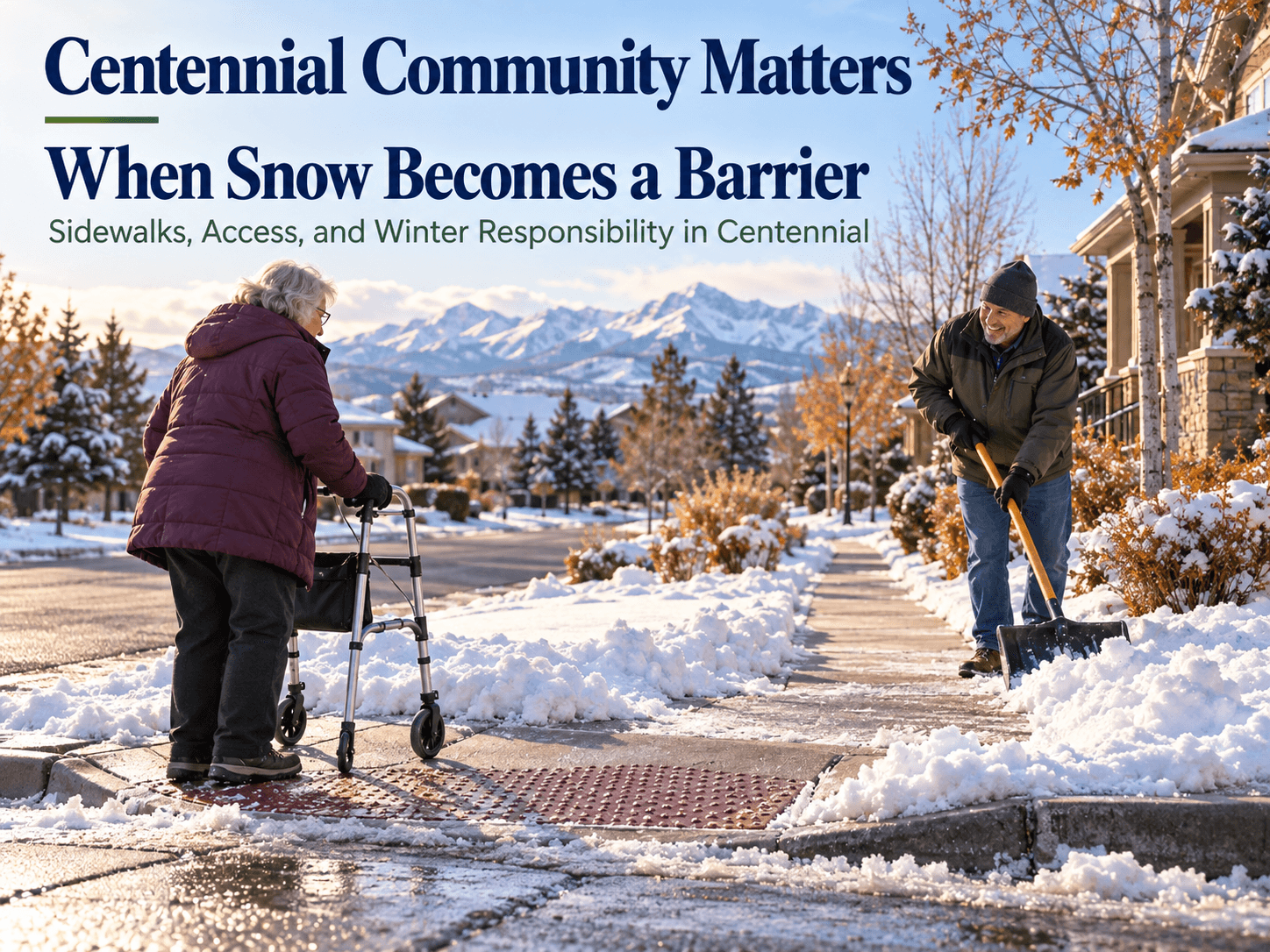
For someone using a wheelchair, walker or cane, it may be impassable.
For a parent pushing a stroller, a child walking to school, someone with limited balance, or a resident trying to reach a bus stop, that same stretch of snow can change an ordinary trip entirely.
Suddenly, snow removal isn't only about tidy sidewalks.
It's about access.
What Does Centennial Actually Require?
Centennial's rules may surprise some residents.
Under the City's sidewalk snow-removal ordinance, sidewalks adjoining properties other than qualifying single-family residential properties must be cleared when snow or ice accumulation reaches four inches or more. The responsible party has 24 hours after the snowfall ends to clear the sidewalk. Enforcement is complaint-based, and fines begin at $200.
Single-family residential properties are exempt from that particular City requirement.
That doesn't mean residential sidewalks stop mattering.
It simply means that, in many neighborhoods, keeping them usable becomes less a matter of municipal enforcement and more a matter of neighbor-to-neighbor responsibility.
Centennial explains its current snow policies and plowing priorities through its Snow and Ice Control resources. Centennial Snow and Ice Control
Streets and Sidewalks Are Two Different Systems
When snow starts falling, most of us naturally watch for the plows.
Centennial prioritizes major arterial streets first, followed by collector streets that connect residents with schools, businesses and other destinations. Many local residential streets fall into Priority 3 and are generally plowed only when certain storm conditions warrant it.
But clearing a street doesn't automatically create an accessible route.
Centennial notes that snow can sometimes be pushed onto sidewalks during plowing, particularly during poor visibility or on narrower streets. If that happens, the City does not routinely return to remove that snow from the sidewalk, although residents can report the situation to the City's Citizen Response Center.
There is another wrinkle: residents and businesses cannot shovel or plow snow from private property, driveways or sidewalks into the street or gutter. Doing so can contribute to drainage problems and refreezing and is prohibited.
So the humble shovel has more civic significance than we might have imagined.
Accessibility Can Disappear Overnight
An accessible sidewalk in July may not be accessible in January.
A curb ramp covered by a plowed snowbank is no longer much of a curb ramp.
A sidewalk narrowed to twelve inches by packed snow may technically still exist, but it may be unusable by a wheelchair or walker.
A patch of refrozen meltwater can become a serious obstacle for someone whose balance isn't what it once was.
Centennial's broader transportation planning recognizes that safe streets should work for people regardless of age, ability or whether they are walking, cycling, using a mobility device, taking transit or driving. The City's Safety Action Plan was adopted in 2025 with that broader approach to transportation safety.
Winter doesn't erase that principle.
If anything, winter tests it.
The Most Important Five Feet May Be Next Door
There is an appealingly simple part of this problem that doesn't require a study, a bond measure or a construction project.
Sometimes it requires looking beyond our own driveway.
After a storm, consider the neighbor who is older, recovering from surgery, living with a disability or simply unable to shovel several inches of heavy Colorado snow.
Maybe clearing another stretch of sidewalk takes ten extra minutes.
Maybe several neighbors share the job.
Maybe an HOA or neighborhood group creates an informal list of residents who could use help after larger storms.
Maybe we simply notice the curb ramp at the end of the block instead of stopping where our own property ends.
That's not a replacement for good public infrastructure.
It's what community looks like in the spaces between the infrastructure.
A Few Things We Can Do Before the Snow Arrives
There are practical steps Centennial residents can take now.
Know which streets near your home are Priority 1, 2 or 3 so you have realistic expectations during a storm. The City provides an interactive snow-plow priority map for residents. Centennial Snowplow Priority Map
Check the sidewalks and curb ramps you use regularly and notice where drainage or shade tends to create recurring ice.
If ice forms in the street gutter and begins forcing water onto a sidewalk, Centennial allows residents to request an inspection for possible residential ice-cutting service through Public Works.
And perhaps most importantly, know who around you might need a hand after the next storm.
A Clear Path Is More Than Concrete
We often talk about community accessibility in terms of ramps, sidewalks, crossings and transportation systems.
Those things matter enormously.
But accessibility is not something we build once and then forget.
A beautiful sidewalk buried beneath eight inches of snow isn't particularly accessible.
A curb ramp blocked by a frozen ridge isn't either.
And a neighbor who cannot leave home because the pathway outside has become impassable isn't experiencing the same Centennial as the person who can simply step over it.
So when the first flakes eventually fall, perhaps the question isn't only:
"Did I clear my sidewalk?"
Maybe it's:
"Can the people around me still get where they need to go?"
Because sometimes building a connected community begins with nothing more complicated than clearing a path.


27 Comments
Join the conversation
Just checked the city map. My street is Priority 3 so I won’t expect quick plowing. At least I can let neighbors know too.
T. DiggsYeah, it's good to know which roads get cleared first so everyone can plan. My block is Priority 3 too, so I usually warn new neighbors so they aren’t surprised if we’re snowed in a bit longer.
Happy to help out but would be nice if the city did more after plows block sidewalks. It’s tough on the elderly.
Having used a cane after knee surgery, I can say uncleared sidewalks are a real pain. Hope more people think about it this year.
Thank you for sharing your personal experience, stories like yours highlight the importance of keeping sidewalks accessible for everyone, especially during challenging weather.
Some of these rules are news to me. Appreciate the heads-up. I’ll ask my HOA if we can organize something this winter.
It's wild how fast the conditions can change. Dry sidewalk one day, icy hazard the next. Gotta stay on top of it.
I love the idea of neighborhood groups keeping lists for folks who need help after storms. Simple way to look out for each other!
The city plows always leave a mound right in front of my driveway. Wish they'd pay closer attention to blocking ramps and sidewalks.
We have an older couple next door and my teenagers take turns clearing their sidewalk. It’s a good lesson for them.
I walk my dog every morning and some sidewalks are never shoveled. Makes it hard for everyone, not just people with disabilities.
You're absolutely right, uncleared sidewalks create barriers for everyone, and a little extra effort goes a long way toward making our community safer for all.
I learned the hard way you can't just toss the snow into the street. Got a warning last year.
Does anyone know how to find the snow plow priority map mentioned? I always feel lost during big storms.
I feel like $200 for not clearing a sidewalk is steep, but maybe that's what it takes for some businesses to do it.
We live on a corner lot and it’s a pain, but I always clear the ramps for the bus stop. Everyone deserves to get to work or school safely.
Lucky for us, most neighbors pitch in after a storm. But I agree that some folks could be more aware especially on corners.
Thank you for reminding us that a clear sidewalk isn't just about looks. It's about access for everybody. I’ll start paying closer attention.
I wish the city enforced residential sidewalk clearing. My street gets packed ice all winter and it's impossible to walk with a stroller sometimes.
We have a text chain on our block for snow shoveling. If anyone needs help, we just jump in. It only takes a bit of coordination.
Never thought about how a patch of ice can stop someone with limited balance. I've almost slipped a few times myself!
I get annoyed when folks shovel their snow right into the street. It always just freezes overnight and gets worse.
Our neighbor always clears our sidewalk when it snows. It helps so much, especially since my mom uses a walker now. Community really matters.
Honestly, I see so many curb ramps blocked by plow piles every year. I wish the city would come by and clear those too, not just the streets.
This is a common challenge, and while the city prioritizes street clearing, residents can report problematic plow piles to the Citizen Response Center for possible follow-up.
I had no idea single-family homes are exempt from clearing sidewalks in Centennial. Makes me want to double-check what my neighborhood does after storms.
Thank you for reading closely, the single-family exemption often surprises residents, and your awareness can help encourage neighbor-to-neighbor responsibility throughout the winter.