Centennial sits only a short drive from Denver, yet proximity does not always mean understanding.
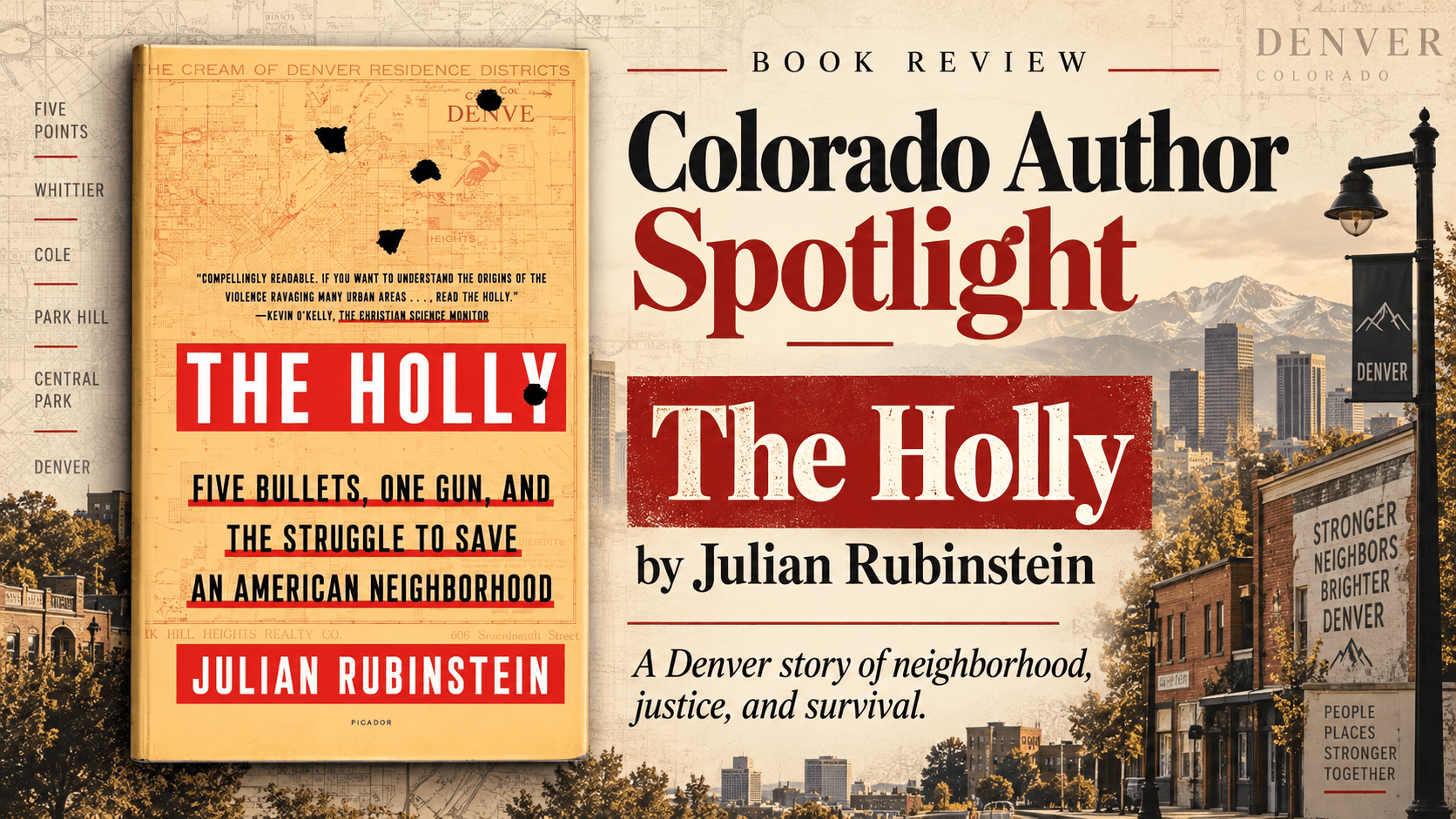
In The Holly: Five Bullets, One Gun, and the Struggle to Save an American Neighborhood, Denver-based journalist Julian Rubinstein takes readers into northeast Denver and asks us to look beyond the version of the city most often seen from highways, downtown offices, or weekend outings.
At the center of the book is a 2013 shooting outside a newly opened Boys & Girls Club in a neighborhood known as the Holly. The shooter was not an anonymous gang member. He was Terrance Roberts, a respected anti-gang activist who had spent years trying to reduce violence in the community. His actions that night left another man paralyzed and eventually placed Roberts on trial, facing the possibility of life in prison.
Rubinstein uses that moment as the doorway into a much larger story.
Rather than treating the shooting as an isolated crime, he traces generations of Denver history, including Black migration from the Jim Crow South, housing discrimination, white flight, gang activity, policing, confidential informants, redevelopment, and the unintended consequences that can accompany efforts to “improve” struggling neighborhoods.
That broader perspective is what makes The Holly especially compelling for readers across the Denver metro area.
It is easy to talk about public safety, crime, development, or neighborhood decline from a distance. Rubinstein asks readers to move closer. What happens when redevelopment raises property values but longtime residents feel pushed aside? What happens when anti-violence programs, law enforcement strategies, political ambitions, and community relationships collide? And what if the people labeled simply as “the problem” are living inside circumstances far more complicated than the label suggests?
Those questions do not belong exclusively to northeast Denver.
Centennial is also part of a rapidly changing metropolitan region where conversations about growth, affordable housing, public safety, policing, development, and community identity increasingly overlap. The Holly offers an opportunity to consider those issues through the experiences of people living only miles away.
Rubinstein grew up in Denver and later returned to report this story in extraordinary depth. The book became a New York Times Book Review Editors’ Choice, won the 2022 Colorado Book Award for General Nonfiction and the High Plains Book Award for Creative Nonfiction, and later became the basis for an investigative documentary.
This is not an easy book, and it is not designed to deliver tidy heroes and villains.
That may be its greatest strength.
The Holly challenges readers to resist quick conclusions and look instead at systems, histories, individual choices, and the human beings living where all of those forces meet.
For Centennial readers, it offers something valuable: a chance to better understand a neighboring community, and perhaps to become more thoughtful about the assumptions we carry into conversations about our own.
Purchase The Holly by Julian Rubinstein on Amazon.
28 Comments
Join the conversation
I live in Centennial, and I agree, understanding our neighbors is more important now than ever. Time to get outside our own bubble.
Can anyone recommend if the doc is worth watching too? Sometimes I prefer that over a nonfiction book. But sounds like the story matters.
Sometimes I feel like these books just preach to the choir, but I hope this one actually changes some minds in Denver.
Never heard about this case before. I wonder what happened to Terrance Roberts after his trial. Might pick up the book to find out.
That’s a great question, without giving too much away, the book delves deeply into Roberts’s life after the shooting and his ongoing role in the community.
Nice to see complicated stories told fully. It’s too easy to forget the people behind the stats and headlines. On my to-read list.
Development is great but not if it shoves out the people who made a community. Hope this book gets that message through.
Tim W.I feel the same way. Redevelopment should include the people who’ve been there all along, not just cater to newcomers. Hope more folks pay attention to that.
Thanks for highlighting this. Always looking for books about local stories instead of the usual national stuff.
I like that it doesn’t try to deliver ‘tidy heroes and villains’. Life really isn’t that simple. Might learn something new from this.
The history piece is what interests me most. Too often, people gloss over how these problems built up over generations.
These are problems all over the metro, not just the Holly. Hope folks in Centennial realize it could easily happen closer to us too.
Congrats to the author for the awards. Didn’t expect a neighborhood story to get so much attention. Makes me want to read it more.
Not sure how I feel about the message. Sometimes people just make bad choices. But I’ll give it a shot to see if it changes my mind.
I hadn’t realized Rubinstein is local and went back to cover it. Feels more authentic when someone really understands the area.
Reading about housing discrimination and white flight hits close to home. My parents left Detroit for similar reasons. Denver isn’t unique that way, sadly.
Thank you for sharing your experience. As the article notes, Denver’s story of migration, discrimination, and neighborhood change reflects patterns seen across many American cities.
I’ll admit I’ve had my own assumptions about northeast Denver. Maybe this would be good for challenging the way I usually think about things.
My son went to that Boys & Girls Club for a few years. The neighborhood is complicated. Glad someone is telling its story honestly.
Thank you for your perspective. The article highlights how Rubinstein’s work aims to portray the Holly’s complex reality, challenges and all, with honesty and depth.
Wish more conversations in Centennial actually talked about the tough stuff in Denver. We act like we’re totally separate but we’re not. This could help.
Hearing that the book became a documentary too has me intrigued. Sometimes you need both words and images to fully understand a place like the Holly.
Absolutely, the documentary brings another layer of insight, but Rubinstein’s reporting in the book offers the deep context that images alone can’t always convey.
So many books just blame gangs or police without looking at bigger patterns. This one seems like it connects the dots. I’ll look for it at the library.
I’m not sure if I agree with the idea that there aren’t any simple villains, but I appreciate anyone trying to show all sides. Might have to check this one out.
Glad the article pointed out how redevelopment can sometimes hurt longtime residents. I’ve seen that happen all over Denver. Interested to see how the book covers that topic.
I didn’t know about Terrance Roberts before, but it’s wild how someone doing anti-gang work could end up in that situation. Makes you think twice about judging at first glance.
I grew up not far from the Holly and remember when the Boys & Girls Club opened. This book sounds like it really digs into what people have lived through in that area. Putting this on my reading list.