

Winter-Ready Wheels: Five Small Moves Before the First Real Snow |
Colorado's traction law can apply on any state highway, and fines start at $100 plus a surcharge. Five quick CDOT-backed checks get your car ready before the next storm. |
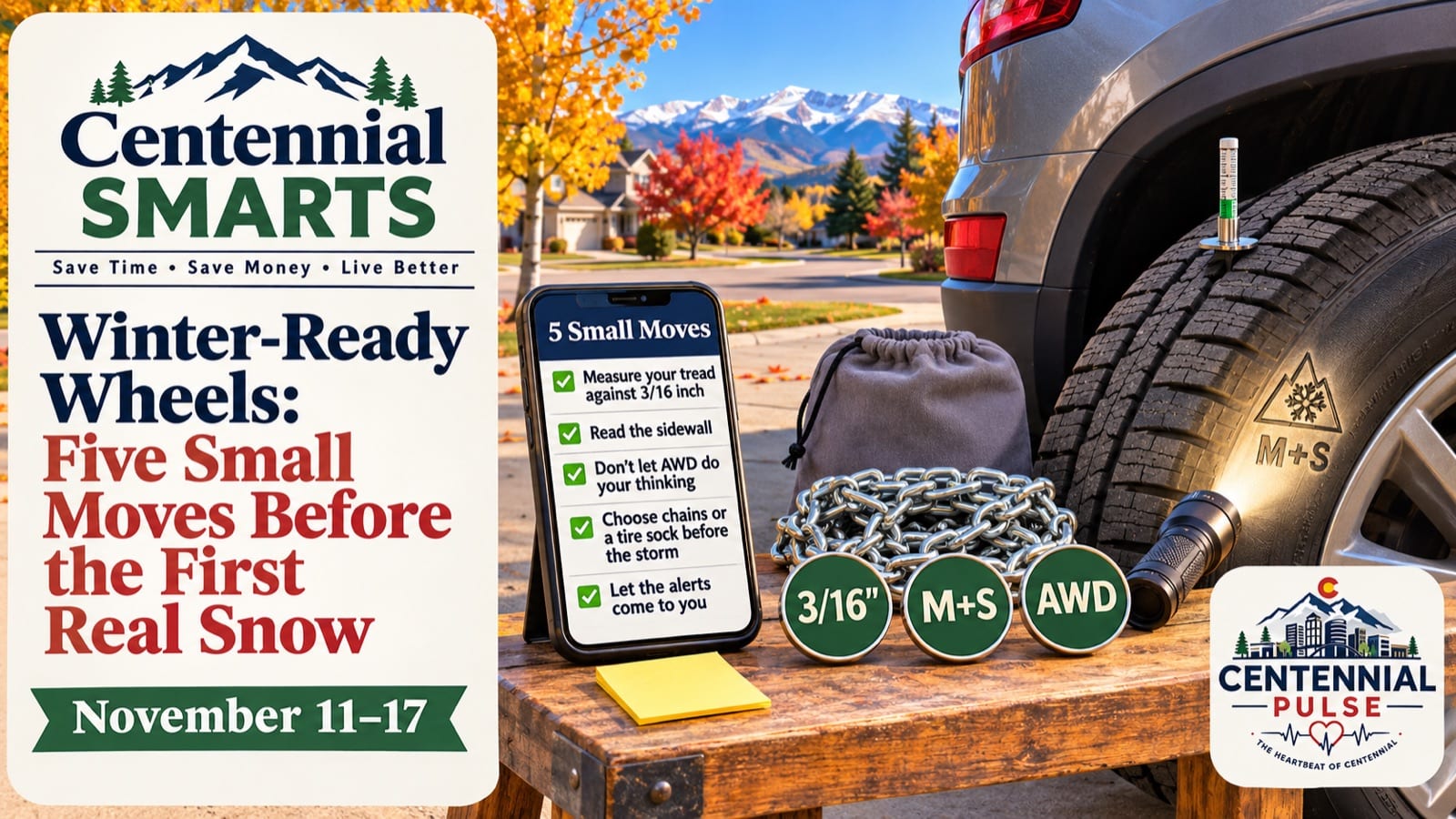
Snow season is a good time to spend ten minutes in the driveway. Colorado's Passenger Vehicle Traction Law isn't only a mountain-pass rule. The Colorado Department of Transportation says it can put traction and chain laws in effect on any state highway, and it implements the traction law "during winter storms, or when conditions require."
Being caught unprepared costs real money. CDOT lists a $100 fine plus a $33 surcharge for not complying. If your vehicle ends up closing a travel lane, the penalty can reach a $500 fine plus a $157 surcharge. Here are five small moves that help you avoid both. (CDOT Traction Law)
1. Measure your tread against 3/16 inch
Under the law, passenger vehicles need tires with at least 3/16" of tread depth. Most tread gauges read in 32nds of an inch, so you're looking for 6/32 or more. Check all four tires, not just the fronts. As the next tips explain, every tire counts.
2. Read the sidewall
Tread depth is only half the rule. The tires also have to be rated winter or all-weather. That means the mountain-snowflake symbol, or an M+S or M/S marking. A phone flashlight and 30 seconds per tire will tell you.
If you run dedicated winter tires, CDOT's FAQ says leaving them on year-round isn't recommended. Their softer rubber is made for cold, and harder all-weather and all-season compounds do better in warm weather. Put a spring swap on the calendar now. (CDOT Winter Driving FAQs)
3. Don't let AWD do your thinking
All-wheel and four-wheel drive do satisfy the law, but only if all tires have at least 3/16" of tread. CDOT "highly recommends" AWD or 4WD in the mountains. Its FAQ is also blunt: those systems may help you accelerate, but for stopping and turning, "nothing is more important than your tires." (CDOT Winter Driving FAQs)
4. Choose chains or a tire sock before the storm
If your tires don't qualify, the law's alternative is to carry chains or an approved alternative traction device. The chain law is CDOT's "final safety measure before the highway is closed." When it's called, every vehicle needs chains or an approved device.
CDOT's approved options include AutoSock, EasySox, ISSE Tire Sock and Alpha Trax cable chains. The full list is at apl.codot.gov. Whatever you buy, try fitting it once on a dry driveway. That beats learning on a snowy shoulder. (CDOT Traction Law)
5. Let the alerts come to you
CDOT announces traction and chain laws through highway signage, COtrip.org and roadway alerts. You can also call 511 or check COtrip.org before you leave. Free text or email alerts are available at subscription.cotrip.org. CDOT's winter-driving hub also links to GoI70 for mountain-corridor trips. (CDOT Winter Driving)
This week's challenge
Before Tuesday, Nov. 17, do two things for every car in your household:
Check all four tires for 3/16" of tread and a snowflake or M+S marking.
Sign up for CDOT alerts on at least one route you actually drive.
Jot the results on a sticky note in the glovebox. If a tire comes up short, you'll know before the forecast decides for you. |
7 Comments
Join the conversation
A friend got ticketed for tread last year. Not a fun way to learn. Everyone, check those grooves!
Glad they mentioned CDOT alerts. Those emails have saved me from getting stuck more than once.
Thanks for pointing out the spring tire swap. I left my winters on last year and they wore down so fast.
Just checked my tires. All but one look good. Glad I read this before heading to the mountains next weekend.
Can someone tell me if the AutoSock is actually easy to use? I never tried fitting it before.
Didn’t realize the fines were so high for blocking a lane. My old Subaru might need new tires after all…
I always thought my all-season tires were enough. Guess I'll be hunting for that snowflake symbol later today.